


DAY 1 : ARRIVE IN HA NOi
Meet at 14:00 at the reception of the hotel.
HANOI CITY : is the capital of Northern Vietnam and keeps this role until now. The city is located on the right bank of the Red River and far about 1760 kilometers from Ho Chi Minh City. Hanoi features a warm humid subtropical climate with plentiful precipitation. In addition, Hanoi is considered one of the main cultural centers of Vietnam, where most Vietnamese dynasties have left their imprint.
Begin to discover the city:
Ho Chi Minh’s Stilt House : this humble, traditional stilt house where Ho lived intermittently from 1958 to 1969 is set in a well-tended garden adjacent a carp-filled pond and has been preserved just as Ho left it.
One pillar pagoda : a wooden pagoda on a single stone pillar, and it is designed to resemble a lotus blossom, which is a Buddhist symbol of purity, since a lotus blossoms in a muddy pond.
Temple of Literature : founded in 1070 by Emperor Ly Thanh Tong, the Temple of Literature is dedicated to Confucius (Khong Tu). Inside you’ll find a pond known as the ‘Well of Heavenly Clarity’, a low-slung pagoda and statues of Confucius and his disciples. A rare example of well-preserved traditional Vietnamese architecture, the complex honours Vietnam’s finest scholars and men of literary accomplishment. It is the site of Vietnam’s first university, established here in 1076, when entrance was only granted to those of noble birth.
Continuation of the visit of the Ngoc Son Temple was built in the 18th century on Jade Island in the centre of the ‘Lake of the Returned Sword’ or Hoan Kiem Lake. Legend describes how an emperor was once given a magical sword which helped him defeat the Chinese Ming Dynasty and in doing so saw the return of the Golden Turtle God to the lake.

Having dinner.
Overight at the hotel
DAY 2 : HANOI – DUONG LAM – HA NOI
Breakfast at the hotel
Depart to Duong Lam Ancient Village : is a commune of Son Tay town, Hanoi, Vietnam. Duong Lam becomes the first ancient village in Vietnam. Two of Vietnam’s kings, Phung Hung (761-802) and Ngo Quyen (896-944) were born in Duong Lam, giving the village its prestige. Today, Duong lam village still retains most of the basic characteristics of a village of Vietnam with port village, trees, courtyard, temples, well, water fields… The roads of Duong lam were special because they have the shape as the bones of fish. Some features are still kept in Duong Lam ancient village is the old village gate in Mong Phu village.
Back to Hanoi.
Lunch at the local restaurant.
Visit the Ethnographic Museum (closed every Monday).
Afternoon free for the walk in the neighborhood of 36 corporations.
Dinner at the local restaurant.
Overnight at the hotel.
DAY 3 : HANOI – HA LONG
Breakfast at the hotel
Early in the morning depart to Halong Bay. Along the way stop at handicraft workshops of handicapped people of Dai Viet. Boarding aboard a traditional junk. Start of the cruise.
Seafood lunch.
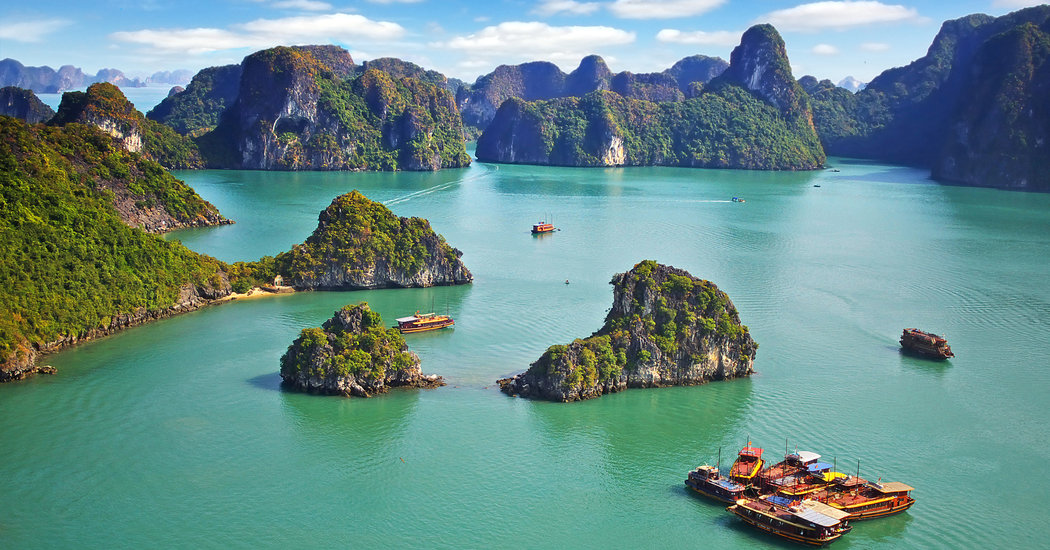
Ha Long Bay : in the Gulf of Tonkin, includes some 1,600 islands and islets, forming a spectacular seascape of limestone pillars. It was called ‘the wonder standing in the heaven’. In the heart of stone islands, there have the beautiful caves such as Thien Cung Cave, Dau Go Cave, Sung Sot Cave, and Tam Cung Cave that are really the castles of the heaven. With the special values, on December 17th 1994, in the 18th session of World Heritage Committee of UNESCO, Halong Bay was officially recognized as the World natural heritage. In November 2000, Halong Bay was recognized by UNESCO as the World natural heritage about the values of geomorphology. On April 27th, officially stated that Halong Bay became one of the Seven Wonders of the World.
Dinner and overnight on board.
(The nature of the visits being related to the change of tides and the weather conditions, the itinerary will be defined by the boat’s captain the same day.)
DAY 4 : HA LONG – NINH BINH
You will start your morning while freshness on the deck, undoubtedly admiring a sunrise over the Bay (depending on the weather).
Breakfast on board, then you will visit Luong cave (tunnel cave). Back on your junk, the cruise will continue to discover the Bay. Landing.
Lunch at the local restaurant.
Depart to Ninh Binh. Scenes of Vietnamese peasants’ country life will accompany you all the way.
Having dinner.
Overnight at the hotel.
DAY 5 : NINH BINH – DIEN CHAU
Breakfast at the hotel
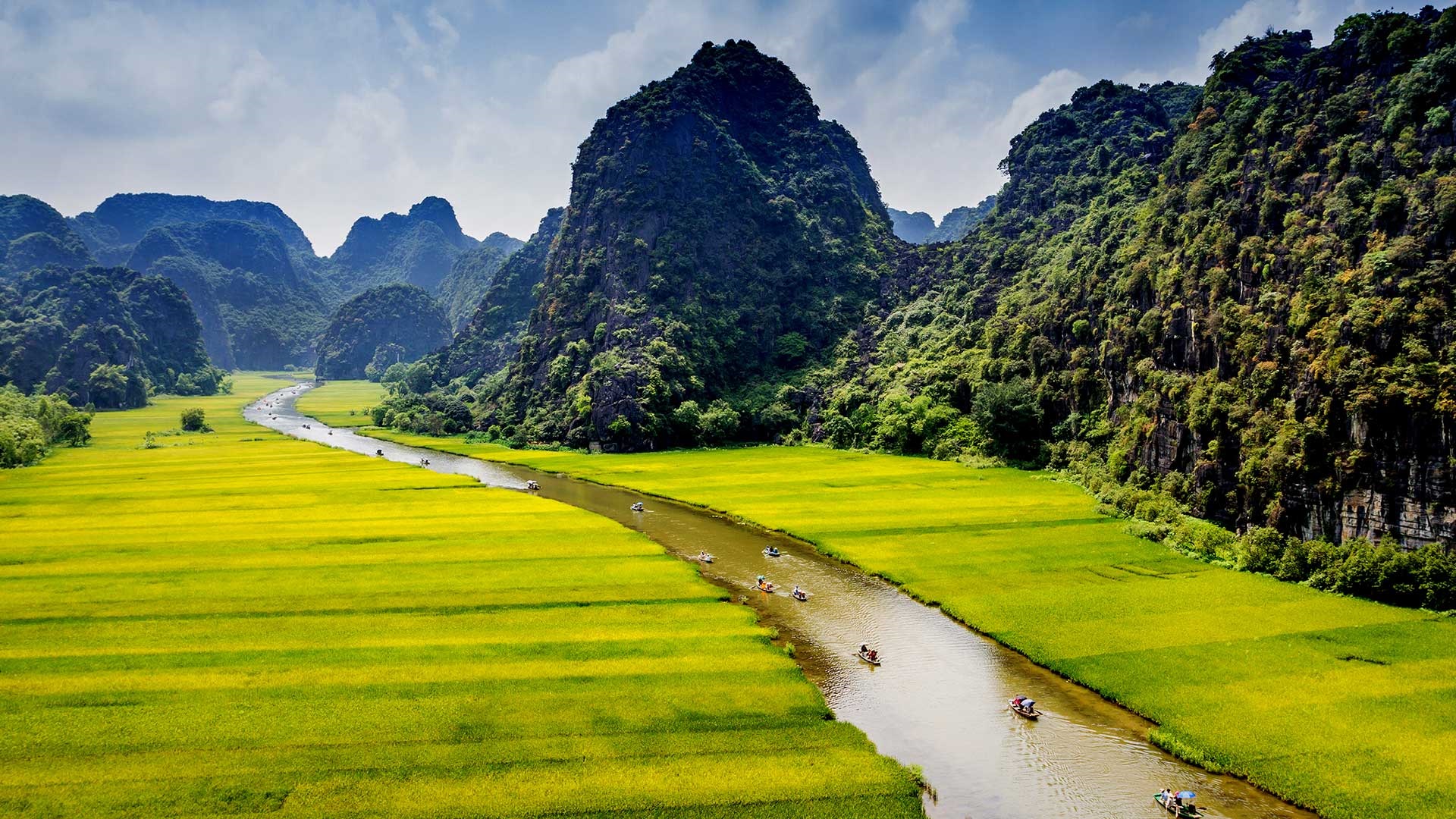
Visit Halong Bay On Land covers a very large swampy area with various rocky landscapes, limestone mountains, the ecosystem where the flora and fauna are very varied, lakes, flooded rice land, and countless river routes offering its visitors a special impression. Halong Bay on Land has several beautiful caves to discover like: Thien Ha (Galaxy Cave), Thien Thanh (Cave of Blue Sky), Tien (Fairy Cave), Vai Gioi (Prayers to Heaven Grotto), Thuy Cung (Aquarium Grotto), Phat (Buddha Cave), Tam Coc (Three Caves), Trang An caves … and several archaeological sites of big values such as Hang Me, Hang Boi, Hang Trong, May Oc….Furthermore, this are still many historical, cultural monuments in the ancient capital of Hoa Lu dating from 938 to 1009, many other historical relics of Vietnamese dynasties such as: Dinh, Le, Ly and Tran, palace of Vu Lam, Jade pagoda, the temples of Dinh Tien Hoang, Le Dai Hanh, Thai Vi …without forgetting the magnificent bird sanctuaries in the Thung Nham valley, Thung Nang valley or Sun valley…
Boat trip of 1h30 among the rice fields that surround the sugar loaf hills where served the decor of the film ” Indochina ”.
Then, visit the temples and caves of Bich Dong.
Depart to Phat Diem Stone Cathedral : is one of the most famous and beautiful churches in Vietnam with special architecture: an elegant combination between Western church architecture style and Vietnamese religious buildings. This is an Eastern architectural ensemble including Lake, Phuong Dinh, cathedral with 4 churches on the sides, 3 man-made grottos, stone churches
Lunch at the inhabitant.
Transfer to Vinh by road.
Having dinner.
Overnight at the hotel.
DAY 6 : DIEN CHAU – DONG HOI
Breakfast at the hotel
Depart to the south through beautiful landscapes.
Lunch at the local restaurant.
Amazing visit the huge Phong Nha caves by boat and on foot.
Phong Nha Caves : only 60km away from Dong Hoi City, this number one cavern in Vietnam has become an increasingly famous attraction in recent years. Phong Nha Cavern has many sections, with a total length of up to 20km. The mouth of the cavern has a width of 20m and a height of 10m. Phong Nha has more than 20 caves with a huge 1500m-long main hall as well as many supplement halls which are hundreds meter long. The outer caves have 10m high ceilings and the inner caves have 25-50m high ceilings. It is hard and even nearly impossible to describe in words the majestic beauty of those caves and halls painted with the glistering color of underground water reflecting on huge blocks of stalagmites and stalactites.
Installation at Dong Hoi Hotel. Having dinner.
Overnight at the hotel.
DAY 7 : DONG HOI – HUE
Breakfast at the hotel
Early depart by the road N° 1 while continuing our progression towards the south.
Visit Vinh Moc tunnels, the center of the Viet Cong resistance against the Americans and the 17th parallel bridge, a natural border between the two regions from 1954 to 1975.
Arrive in Hue and have lunch.
Hue : is located in central Vietnam on the banks of the Huong River, a few miles inland from Bien Dong. It is about 700 kilometers south of the Hanoi national capital and about 1100 kilometers north of Ho Chi Minh City. Throughout the centuries, the quintessence of country converges here to create a fantastic natural picture with romantic river and charming mountain. The architecture seems to be mixed with wonderful nature, which creates the charming picture.Today, Hue becomes the typical city of Vietnam. Every two years, people welcome Hue festival.
Visit of the Imperial City built under the model of Chinese imperial palaces the citadel was built between 1805 and 1832
There are many remains of this city.
Then you will ride a pedicab to Dong Ba market you will find the most beautiful conical hats of Vietnam.

Having dinner. Night at the hotel .
Overnight at hotel in Hue.
DAY 8 : HUE
Breakfast at the hotel
Depart to the sampan on the Perfume River to the Lady Celeate Pagoda (Thien Mu), located on the left bank of the Perfume River, it is a Buddhist sanctuary raised in 1601. Its stupa of form octagonal has 7 floors with a total height of more than 21 meters.
Visit the charming Temple of Eunuchs.
Stop at incense workshops and conical hats.
Visit the tomb and gardens of Emperor Tu Duc.
Lunch at the local restaurant.
Demonstration of Tai Chi and Calligraphy (minimum 10 pax) in a martial arts center:
Tai Chi is a body discipline of Chinese origin with a set of continuous and circular movements performed slowly and accurately in a pre-established order. It also focuses on the control of breathing. The practice aims to improve flexibility, strengthen the muscular system and maintain good physical, mental and spiritual health.
Directly inspired by Chinese calligraphy, calligraphy was introduced in Vietnam during the long periods of occupation of the country by the Chinese emperors.
You will attend a puppet show on the water.
Royal dinner (minimum 16 pax) and overnight at the hotel in Hue.
DAY 9: HUE – DA NANG – HOI AN
Breakfast at the hotel
Through the tunnel, drive to Hoi An. Stop at Danang, visit a marble workshop: this trade has been passed from generation to generation for hundreds of years.
Hoi An : is one of the most famous destinations in the middle part of Viet Nam , 30km far from Da Nang. Hoi An ancient town was recognized as the World heritage by UNESCO. Moreover, the diverse cultural influences remain visible today from the culture of Kingdom of Champa ,the Asian culture of Japanese, Chinese, Indian and the Western culture during the trading time from the 16th century. Since 1998, the Hoi An resident decided to preserve one of the beautiful culture that’s using colored lanterns. On the 14th of each lunar month, residents will switch off their lights and hang cloth and paper lanterns on their porches and windows. Others electronics as TV, radios, street lights and neon lights are turned off, and a sparkling, romantic and mysterious view is opened. Hoi An residents place offerings of food and incense on their ancestral altars and then go to visit the pagodas. The scent of incense and the sounds of people singing add to the town’s enchanted atmosphere.
Discovery on foot from Hoi An with the main centers of interest:
Fujian Assembly Hall in Hoi An : Originally a traditional assembly hall, this structure was later transformed into a temple for the worship of Thien Hau, a deity from Fujian province. The green-tiled triple gateway dates from 1975. The mural on the right-hand wall depicts Thien Hau, her way lit by lantern light as she crosses a stormy sea to rescue a foundering ship. Opposite is a mural of the heads of the six Fujian families who fled from China to Hoi An in the 17th century.
Phuc Thanh Pagoda: the oldest pagoda of Hoi An (1454) founded by a Chinese monk, it contains a statue of Buddha A Di Da and very beautiful ritual objects.
The Japanese Covered Bridge : in Hoi An is one of the famous tourist attractions in Hoi An, Vietnam. The original Vietnamese name of this bridge is “Lai Vien Kieu”. The bridge was built in the early seventeenth century. However, the builder of the bridge is still anonymous to the people of Hoi An. The Japanese Covered Bridge in Hoi An is a beautiful example of Japanese architecture. At one end of the bridge, there is a sculpture of dog and on the other end of the bridge here is a sculpture of monkey. These two animals are symbol of sacredness in Japanese culture. Inside the Japanese Covered Bridge in Hoi An, there is a temple of the northern god Tran Vo Bac De. This god is considered to be the god of weather. People believe that He controls all kinds of weather changes and natural calamities.
An Old House: the best preserved, two centuries old, it offers a striking example of the integration of Sino-Japanese influences to the local style.
Lunch at the local restaurant.
Excursion with Ecotourism:
Departure by bike through the sweet Vietnamese companion for the vegetable village of Tra Que (Located 5kms).
Renowned for its aromatic herbs, mint and basil, this village will allow you to discover the life of farmers and introduce you to their technique. The locals will guide you in the work of digging and picking vegetables.
You will then enjoy a session of foot massage (20mns) with the aromatic herbs of the village.
Having dinner. Overnight at the hotel.
DAY 10: HOI AN
Breakfast at the hotel ,
Morning: visit My Son Sanctuary : about 70km southwest of Danang City and 40km from Hoi An City. Of the 225 Cham vestiges that are founded in Viet Nam, My Son possesses 71 monuments and 32 epitaphs, the content of which is still being studied. According to many researchers, My Son sanctuary architecture was affected by Arabian, Malaysian, Indonesian, especially Indian culture, and it is the convergence of different styles such as ancient style. All of the towers were built from red bricks and sandstone. Today, the brick making and construction remain a secret among many archeologists.Though there are not many remnants left, My Son holly land still boasts the rich culture and arts of ancient Champa kingdom in glorious time .
You will attend a performance of Chams dances.
Lunch.
Afternoon free.

Possibility of a stroll on the night market.
Dinner at the local restaurant.
Overnight at the hotel.
DAY 11 : HOI AN – DA NANG – SAI GON – CAN THO
Breakfast at the hotel ,
Transfer to Danang airport and flight to Saigon.
Depart to Mekong Delta.
An extensive network of thousands of canals characterizes life in the Mekong Delta stretching 40,000 square kilometers. The yellow color of the water is due to the soil that fertilizes the fields and the rich fruit gardens of the Delta all year round. The huge rivers and rice fields are dotted with lotus ponds. The main means of transport is the boat.
Stop on the road to visit the temple of Caodaiste religion.
Arrival at My Tho: boarding a local motor boat and then sailing to the island of Phoenix. During your walk, you will taste the coconut juice of the region.
Lunch specialty of the region at the local restaurant on the island. (Giant gourami).
Boarding then continue to the island of Ben Tre: where you will visit a family candy factory at the base of coconut milk. Departure by horse-drawn carriage and walk to the bee farm, where you will enjoy a honey tea and seasonal fruits.
Boarding a rowing boat in the arroyos.
Depart to Can Tho, installation at the hotel.
Dinner at the local restaurant. Overnight at the hotel.
DAY 12 : CAN THO – HO CHI MINH CITY
Breakfast at the hotel
Can Tho is the capital of Can Tho province and its location makes it the hub of the Mekong Delta.
Boarding on the local boat. Navigation through the Cai Rang Floating Market.
Stop in a traditional factory of rice cakes and in another Nuoc Mam.
Disembarkation then return to Saigon.
Lunch at the local restaurant along the way
Ho Chi Minh city : also known as Saigon is the largest city in Vietnam with the population nearly 9 millions. The city is called ‘Diamond of the Far-East’, the same luxury level overriding Hong Kong or Bangkok. Ho Chi Minh city becomes very important city in Vietnam. The nice location at central of the South Vietnam, Ho Chi Minh city becomes very important center of transportation lead to surrounding provinces , bring opportunities to develop the economy and tourism of Eastern and Western area of the South.
Visit the colonial district of the city: Dong Khoi Street: Formerly known as Rue Catinat during the French colonial days and Tu Do in the 1960s, this street was reborn during Doi Moi as the centre of Saigon’s commercial and shopping district. Local boutiques compete with international brands, and restaurants litter the street set in beautifully restored French colonial buildings.
The Central Post Office : is one of the oldest buildings in Ho Chi Minh City. This was built around 1886 – 1891 based on Villedieu’s design, a famous French architect. It has been the busiest post office of the country. Its architecture, with a roof topped by a glass roof, is reminiscent of the buildings of the World Expo. It is a place where it is nice to stop.
Saigon Notre Dame Cathedral : built in the late 1880s by French colonists, is one of the few remaining strongholds of Catholicism in the largely Buddhist Vietnam. Sitting between two streams of traffic, Notre Dam Cathedral is in the middle of Saigon’s chaotic District 1. A brick, neo-Romanesque church with 40m-high square towers tipped with iron spires. Interior walls are inlaid with devotional tablets and some stained glass survives. In front of the cathedral stands a Virgin Mary statue, which is said to have shed tears in 2005, causing thousands of people to stop around the Basilica.
The Saigon Opera House is owning an elegant architecture.The building still many lively evidences for the influence of French architecture in Vietnam. This magnificent building designed by French architect Ferret Eugene, was built as a classical opera house with 800 seats. The style of this majestic building is influenced by flamboyant style of the French Third Republic. Since 1975, he has returned to his original function.
On the same square The Hotel Continental is a hotel in Ho Chi Minh City, Vietnam. It was named after the Hôtel Continental in Paris, and is located in District 1, the central business district of the city. The hotel is situated on Dong Khoi Street by the Saigon Opera House and was built in 1880 during the French colonial period. The hotel has undergone refurbishments over the years, while still maintaining the essence of its original architecture and style !
The People’s Committee Building of Ho Chi Minh City : was built and put into use in 1909 as a hotel whose original name was Hôtel de Ville. It was designed by Gardes, a famous French architecture. This building is thus one of the oldest, biggest and most beautiful French style buildings in Ho Chi Minh City, functioning both as a city institution and as the city’s most prominent landmark today.
Visit of a factory of lacquered objects.
Free dinner to offer you …

DAY 13 : HO CHI MINH CITY – PHNOM PENH
Breakfast at the hotel
Transfer to the bus station in Saigon.
Depart to Phnom Penh by regular bus
Obtaining a Cambodian visa at the border.
Cost of obtaining a Cambodian visa (payable locally – 37 USD to date)
Arrival and welcome by your local French guide.
Lunch in town.
City tour with the visit of the Royal Palace and the silver roofed pagoda.
Transfer and installation at the hotel.
Dinner and overnight at the hotel in Phnompenh
DAY 14 : PHNOMPENH – SIEM REAP
Breakfast at the hotel
Visit Toul Sleng Museam, Central Market.
Lunch at the local restaurant.
Departure to Siem Reap by public bus Mekong Express, without guide (included).
Arrival in Siem Reap, welcome by our French speaking guide.
Dinner.Transfer to the hotel.
DAY 15 : SIEM REAP
Breakfast at the hotel
Visit the Angkor Thom site, including the The Bayon is a well-known and richly decorated Khmer temple at Angkor in Cambodia. Built in the late 12th or early 13th century as the official state temple of the Mahayana Buddhist King Jayavarman VII , the Bayon stands at the centre of Jayavarman’s capital, Angkor Thom . Following Jayavarman’s death, it was modified and augmented by later Hindu and Theravada Buddhist kings in accordance with their own religious preferences . Then, Phimeanakas, the Terrace of Elephants on which the king and his court attended the processions and the terrace of the Leper King, so called because of a statue that represents a Judge of the Hell with the demonic aspect.
Lunch at a local restaurant.
Afternoon visit Angkor Wat is a temple complex in Cambodia and the largest religious monument in the world, on a site measuring 162.6 hectares (1,626,000 m2; 402 acres). It was originally constructed as a Hindu temple dedicated to the god Vishnu for the Khmer Empire, gradually transforming into a Buddhist temple towards the end of the 12th century. It was built by the Khmer King Suryavarman II in the early 12th century in Yaśodharapura , the capital of the Khmer Empire, as his state temple and eventual mausoleum !
At the end of the afternoon: admiration of the temples at sunset and spectacular view towards Angkor Wat from Bakend mountain.

Dinner traditional Khmer dance show in a local restaurant.
Overnight at the hotel.
DAY 16 : SIEM REAP
Breakfast at the hotel
Visit the Banteay Srei or Banteay Srey is a 10th-century Cambodian temple dedicated to the Hindu god Shiva. Located in the area of Angkor, it lies near the hill of Phnom Dei, 25 km (16 mi) north-east of the main group of temples that once belonged to the medieval capitals of Yasodharapuraand Angkor Thom. Banteay Srei is built largely of red sandstone, a medium that lends itself to the elaborate decorative wall carvings which are still observable today .
Ta Prohm is the modern name of the temple at Angkor, Siem Reap Province, Cambodia, built in the Bayon style largely in the late 12th and early 13th centuries and originally called Rajavihara. Located approximately one kilometre east of Angkor Thom and on the southern edge of the East Baray, it was founded by the Khmer King as a Mahayana Buddhist monastery and university. Unlike most Angkorian temples, Ta Prohm is in much the same condition in which it was found: the photogenic and atmospheric combination of trees growing out of the ruins and the junglesurroundings have made it one of Angkor’s most popular temples with visitors. UNESCO inscribed Ta Prohm on the World Heritage List in 1992..
Breakfast in a local restaurant.
Visit the ANGKOR ARTISANS SCHOOL located in the heart of the city.
Supported by the Ministry of Education, this center was founded in 1992 and seeks to revive Khmer ancestral art. The school receives 250 students a year and gives them training in traditional and traditional techniques. In the buoting, silk clothes and polychrome wooden statues are expensive but are beautiful.
Dinner in a local restaurant.
Overnight at the hotel.
DAY 17 : SIEM REAP – DEPART
Breakfast at the hotel
Visit Tonle Sap Lake is considered the fishermen’s paradise where all their life takes place around the water. Very fishy, it houses lake villages since the dawn of time. It is the largest lake in Cambodia and its “foster mother”.
Morning: we take a boat trip to mingle with the daily life of fishermen at the beautiful floating village of Kampong Pluk.
Breakfast in a local restaurant.