


DAY 1 : PARIS – HANOI
Take off on the flight … to
DAY 2 : ARRIVAL IN HANOI
Arrival in Hanoi at …
Customs formalities and luggage recovery (Estimated time approximately 30 minutes).
You will then be greeted by your guide and driver, outside the airport, transfer to Hanoi city for a day tour of the city
Lunch at the restaurant
HANOI CITY : is the capital of Northern Vietnam and keeps this role until now. The city is located on the right bank of the Red River and far about 1760 kilometers from Ho Chi Minh City. Hanoi features a warm humid subtropical climate with plentiful precipitation. In addition, Hanoi is considered one of the main cultural centers of Vietnam, where most Vietnamese dynasties have left their imprint.
The Old Quarter (36 old streets) : has a history that spans 2,000 years and represents the eternal soul of the city. Ha Noi Old Quarter with its old-styled narrow streets full of antique brick houses seems to nostalgically resist the flow of time while still actively trying to adapt to the dynamic atmosphere of the modern city. Once a bustling area where merchants and artisans gathered to sell their products, Ha Noi Old Quarter consists of many small, meandering streets, each bears the name of the goods that was specifically traded there such as Hang Bac (Silver Product), Hang Ma (Paper Product), Hang Go (Wood Product), just to name a few.
Water Puppet show : is a tradition that dates back as far as the 11th century when it originated in the villages of the Red River Delta area of northern Vietnam. The puppets are made out of wood and then lacquered. The shows are performed in a waist-deep pool. A large bamboo rod supports the puppet under the water and is used by the puppeteers, who are normally hidden behind a screen, to control them. Thus the puppets appear to be moving over the water.

DAY 3 : HANOI
Breakfast at the hotel
Visit :
Temple of Literature : founded in 1070 by Emperor Ly Thanh Tong, the Temple of Literature is dedicated to Confucius (Khong Tu). Inside you’ll find a pond known as the ‘Well of Heavenly Clarity’, a low-slung pagoda and statues of Confucius and his disciples. A rare example of well-preserved traditional Vietnamese architecture, the complex honours Vietnam’s finest scholars and men of literary accomplishment. It is the site of Vietnam’s first university, established here in 1076, when entrance was only granted to those of noble birth.
Ngoc Son Temple was built in the 18th century on Jade Island in the centre of the ‘Lake of the Returned Sword’ or Hoan Kiem Lake. Legend describes how an emperor was once given a magical sword which helped him defeat the Chinese Ming Dynasty and in doing so saw the return of the Golden Turtle God to the lake.
Hoan Kiem Lake (Lake of the Restored Sword) : refers to a legend of the great Vietnamese hero, Le Loi, who led a successful uprising against the Chinese in the fifteenth century. Tradition has it that Le Loi netted a gleaming sword while out fishing in a sampan and when he returned as King Ly Thai To, after ten years of battle, he wanted to thank the spirit of the lake. As he prepared the sacrifice there was a timely peal of thunder and the miraculous sword flew out of its scabbard, into the mouth of a golden turtle (Vietnamese use the same word for turtle and tortoise) sent by the gods to reclaim the weapon.
Lunch at the restaurant. Then free time for shopping at Dong Xuan Market

Dong Xuan market : is the oldest and largest market in Hanoi. Established in 1889, Dong Xuan Market is housed within a four-storey Soviet-style building on the northern edge of Hanoi Old Quarter. It’s also known as Hanoi’s largest indoor market, offering a wide range of goods such as fresh produce, souvenirs, accessories and clothing, as well as electronic and household appliances.
West lake ( Ho Tay) : is the biggest freshwater lake of northwest center of Hanoi, Vietnam. With a shore length of 17 km (about 10.6 miles) and 500 hectare (about 5 km2) in area, this is the largest lake of the capital and a popular place for recreation with many surrounding gardens, hotels and villas.
Tran Quoc Pagoda : is the oldest pagoda in the city, originally constructed in the sixth century during the reign of Emperor Lý Nam Đế (from 544 until 548), thus giving it an age of more than 1,450 years. When founded the temple was named Khai Quoc (National Founding) and was sited on the shores of the Red River, outside of the Yen Phu Dyke. When confronted with the river’s encroachment, the temple was relocated in 1615 to Kim Ngu (Golden Fish) islet of Ho Tay (West Lake) where it is now situated. A small causeway links it to the mainland.
The Imperial Citadel of Thang Long : is an intriguing relic of Vietnam’s history and, signifying its historical and cultural importance, was made a UNESCO World Heritage Site in 2010. Also known as the Hanoi Citadel, many artefacts and items dating back to between the 6th and 20th centuries were excavated in 2004, including foundations of old palaces, ancient roads, ponds and wells.
Dinner at the restaurant
DAY 4 : HA NOI – HALONG BAY
Breakfast at the hotel
Depart to the famous Halong Bay, for a memorable cruise on the bay.
Ha Long Bay : in the Gulf of Tonkin, includes some 1,600 islands and islets, forming a spectacular seascape of limestone pillars. It was called ‘the wonder standing in the heaven’. In the heart of stone islands, there have the beautiful caves such as Thien Cung Cave, Dau Go Cave, Sung Sot Cave, and Tam Cung Cave that are really the castles of the heaven. With the special values, on December 17th 1994, in the 18th session of World Heritage Committee of UNESCO, Halong Bay was officially recognized as the World natural heritage. In November 2000, Halong Bay was recognized by UNESCO as the World natural heritage about the values of geomorphology. On April 27th, officially stated that Halong Bay became one of the Seven Wonders of the World.
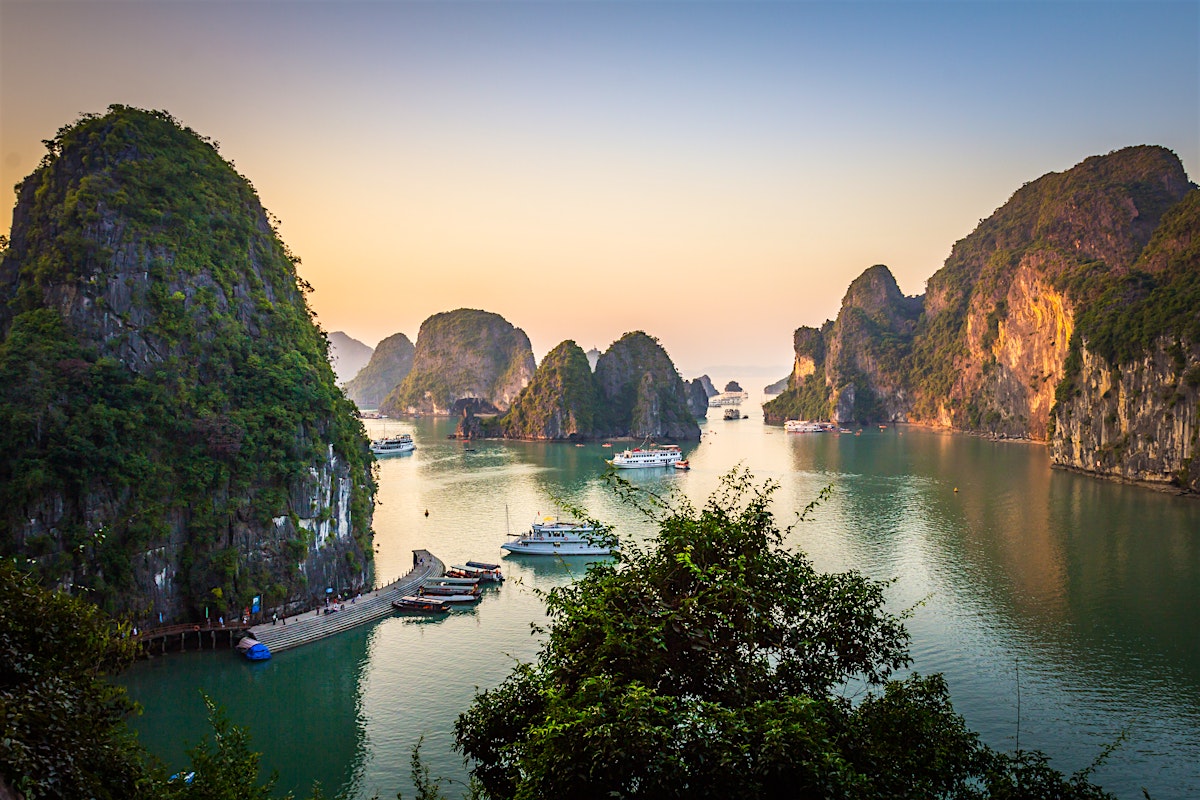
Halong Bay Cruise: On board a junk, you’ll have a memorable cruise. Spend your day admiring one of the natural wonders of Vietnam. Visit islets, caves, If the heart tells you, you can do a dip in the jade waters of the Gulf of Tonkin.
DAY 5 : HALONG BAY – HA NOI – DA NANG – HOI AN
Breakfast at the hotel
Back to Hanoi.
Then transfer to Ha Noi airport for flight to Da Nang.
Lunch at the restaurant
Take off on … on the flight …
Arrival in Da Nang at …
Dinner at the restaurant.
Transfer to Hoi An.
DAY 6 : HOI AN
Breakfast at the hotel
Visit :
Hoi An : is one of the most famous destinations in the middle part of Viet Nam , 30km far from Da Nang. Hoi An ancient town was recognized as the World heritage by UNESCO. Moreover, the diverse cultural influences remain visible today from the culture of Kingdom of Champa ,the Asian culture of Japanese, Chinese, Indian and the Western culture during the trading time from the 16th century. Since 1998, the Hoi An resident decided to preserve one of the beautiful culture that’s using colored lanterns. On the 14th of each lunar month, residents will switch off their lights and hang cloth and paper lanterns on their porches and windows. Others electronics as TV, radios, street lights and neon lights are turned off, and a sparkling, romantic and mysterious view is opened. Hoi An residents place offerings of food and incense on their ancestral altars and then go to visit the pagodas. The scent of incense and the sounds of people singing add to the town’s enchanted atmosphere.
Hoi An ancient town : about 30 km south of Danang. The ancient town of Hoi An is a typical example of traditional ports in Southeast Asia preserved intact and thoughtful. Most of the houses here are the traditional architecture of Hoi An is also the landmark mark of the blend, cross-cultural. With outstanding values, Hoi An ancient city is recognized as a world cultural heritage.
Lunch at the restaurant

Visit the silk workshop: you will discover the whole process of the silk factory and will have the opportunity to order a custom suit that will be delivered within 24 hours.
The rest of the time is dedicated to shopping or various activities at the hotel. Possibility of cycling by asking at the reception of the hotel.
Free time to enjoy An Bang beach or bike ride to Cua Dai beach
Dinner at the restaurant.
DAY 7 : HOI AN – HUE
Breakfast at the hotel
Depart from Hoi An to Hue.
Continue to Hue via the famous cloud pass which offers at its summit a superb panorama of the
coastline of the center.
Arrival Hue, for visiting:
Hue : is located in central Vietnam on the banks of the Huong River, a few miles inland from Bien Dong. It is about 700 kilometers south of the Hanoi national capital and about 1100 kilometers north of Ho Chi Minh City. Throughout the centuries, the quintessence of country converges here to create a fantastic natural picture with romantic river and charming mountain. The architecture seems to be mixed with wonderful nature, which creates the charming picture.Today, Hue becomes the typical city of Vietnam. Every two years, people welcome Hue festival.
Hue Citadel : has a circumference of 10 kilometers with the height of 6.6 meters and 21 meters thick with forts being meanderingly arranged, accompanied by cannons, artilleries and ammunitions. Initially the fortress was built solely by soil, only to be replaced by bricks afterward. Surrounding the city is the complicated canal system served not only as a protection but also as a waterway with nearly seven kilometers. There are total of ten main majestic gates leading to the Imperial City of Hue. All the typically traditional Eastern architectures including majestic palaces, tombs and museums stand accordantly together to make an utmost amusing attraction right in the heart of Vietnam.Famously being one of Vietnam’s seven UNESCO World Heritage Sites.
For a very long time, the image of young women with “non la” (conical hats) and ao dai (Vietnamese gown) has become a symbol of Hue people and Hue tourism. To see how conical hats are made and to learn more about the culture and people of Hue, you should visit a conical hat making village.
Lunch at the restaurant.

Tu Duc Tomb is considered as one of the most beautiful and picturesque and largest works of architecture of Nguyen Dynasty’s royal palaces and tombs. People say that Tu Duc Tomb is a must in every tour to Hue City.
The village making conical hats.
Thien Mu Pagoda : is situated on Ha Khe hill, on the north bank of the Perfume River, 5 kilometers from Hue city. The beautiful pagoda was built in 1601. The most striking feature of the pagoda, Phuoc Duyen tower (initially called Tu Nhan tower), was erected in 1884 by King Thieu Tri, and has become the unofficial symbol of Hue. It is the highest stupa in Vietnam, and is often the subject of folk rhymes and cadao about Hue, such is its iconic status and association with the city. More importantly, it is regarded as the unofficial symbol of the former imperial capital. To the left of the tower is a pavilion sheltering an enormous bell. The bell, called Dai Hong Chung, was cast in 1710 by Lord Nguyen Phuc Chu. It is famous for the great size, which is 2.5m high and 3,285 kg weigh.Besides, there are several popular works of art inside the pagoda, which are of great captivation to tourists.
The village of Thuy Bieu: Village typical of the Hue countryside, it is known for a variety of sweet grapefruit, called Thanh Tra, which is there
Discover the village by bike or on foot: orchards and vegetable crops, local crafts,
ancestral houses surrounded by gardens, lineage/family temple dedicated to ancestor worship, house
communal
Dinner at the restaurant.
DAY 8 : HUE – HO CHI MINH CITY
Breakfast at the hotel
Then transfer to Hue airport for flight to Ho Chi Minh City
Takeoff on … on the flight ….
Arrival in Ho Chi Minh City at …
Ho Chi Minh city : also known as Saigon is the largest city in Vietnam with the population nearly 9 millions. The city is called ‘Diamond of the Far-East’, the same luxury level overriding Hong Kong or Bangkok. Ho Chi Minh city becomes very important city in Vietnam. The nice location at central of the South Vietnam, Ho Chi Minh city becomes very important center of transportation lead to surrounding provinces , bring opportunities to develop the economy and tourism of Eastern and Western area of the South.
The Central Post Office : is one of the oldest buildings in Ho Chi Minh City. This was built around 1886 – 1891 based on Villedieu’s design, a famous French architect. It has been the busiest post office of the country. Its architecture, with a roof topped by a glass roof, is reminiscent of the buildings of the World Expo. It is a place where it is nice to stop.
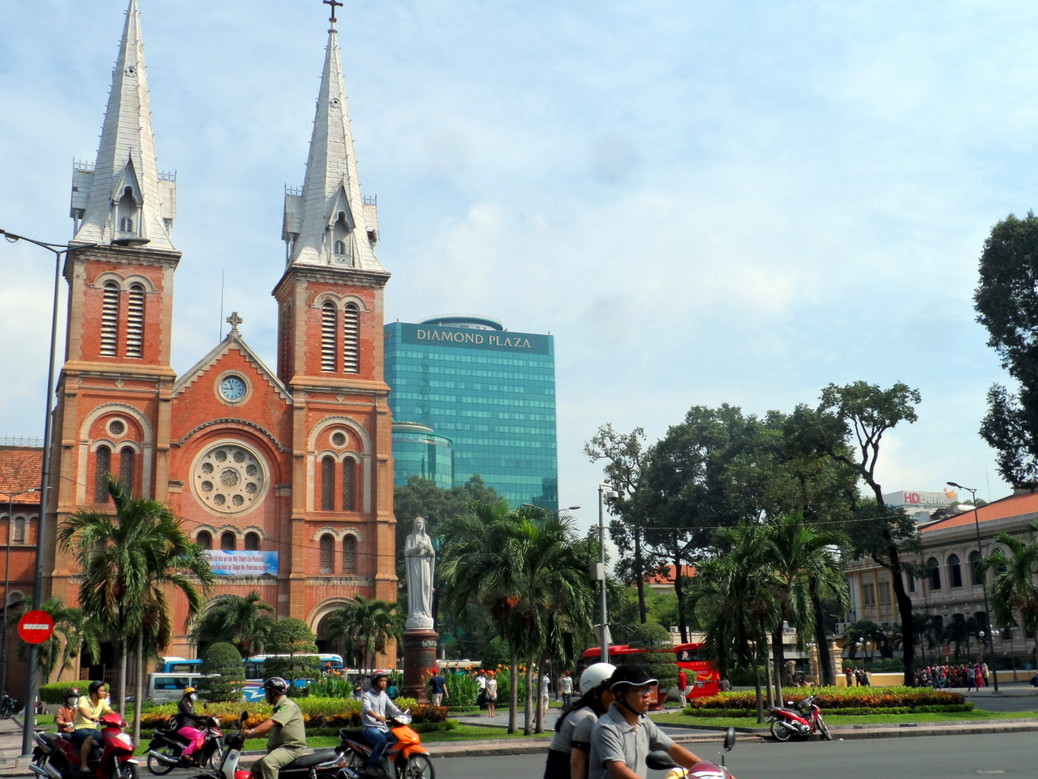
Saigon Notre Dame Cathedral : built in the late 1880s by French colonists, is one of the few remaining strongholds of Catholicism in the largely Buddhist Vietnam. Sitting between two streams of traffic, Notre Dam Cathedral is in the middle of Saigon’s chaotic District 1. A brick, neo-Romanesque church with 40m-high square towers tipped with iron spires. Interior walls are inlaid with devotional tablets and some stained glass survives. In front of the cathedral stands a Virgin Mary statue, which is said to have shed tears in 2005, causing thousands of people to stop around the Basilica .
Lunch at the restaurant.
The lacquer manufacturing workshop : Lacquer-ware refers to wooden or fiberglass objects painted and preserved with lacquer. Lacquer is a clear, water-resistant resin made from the sap of the Rhus Succedanea tree. The application of lacquer to wooden artifacts is an ancient process dating back thousands of years.
Ben Thanh Market : is the most famous shopping destination for tourists in Ho Chi Minh City, featuring every type of souvenir the spending traveler desires to buy. The attraction is one of the earliest surviving structures in Saigon and an important landmark of the city. The market was first created as an informal gathering of street vendors near Saigon River…
The People’s Committee Building of Ho Chi Minh City : was built and put into use in 1909 as a hotel whose original name was Hôtel de Ville. It was designed by Gardes, a famous French architecture. This building is thus one of the oldest, biggest and most beautiful French style buildings in Ho Chi Minh City, functioning both as a city institution and as the city’s most prominent landmark today.
The Saigon Opera House is owning an elegant architecture.The building still many lively evidences for the influence of French architecture in Vietnam. This magnificent building designed by French architect Ferret Eugene, was built as a classical opera house with 800 seats. The style of this majestic building is influenced by flamboyant style of the French Third Republic. Since 1975, he has returned to his original function.
Dinner at the restaurant.
DAY 9: HO CHI MINH CITY – MY THO – BEN TRE – HO CHI MINH CITY
Breakfast at the hotel
Depart to My Tho.
MY THO: Tiên Giang province which is considered one of the granaries and orchards of the Mekong Delta. It provides the rest of the country with rice but mostly fruits. We mostly come to My Tho because it is the starting point for boat trips on the Mekong. My Tho offers a good overview of life in the delta.
Mekong delta : is located in Southwestern Vietnam. The water that moves to the rhythms of the mighty Mekong, where boats, houses and markets float upon the innumerable rivers, canals and streams that criss-cross the landscape like arteries. The bustling commerce of its towns contrasts sharply with the languid, almost-soporific pace of life in the countryside. Here buffalo wallow in rice paddies, coconut- and fruit-laden boats float slowly along the mud-brown waters, and two-wheeled exploration of the narrow lanes is amply rewarded with a true taste of rural hospitality.
Arrived at Ben Tre: visit of the coconut caramel factory, horse carriage ride, tasting of fruits, honey tea and honey distilled rice alcohol while listening to traditional music and stroll in the rowing boat.
Return to the boat to go to lunch and taste the Mekong specialty: “the fish with the elephant’s ear”
Return to the city of Ho Chi Minh.
Dinner at the restaurant.
DAY 10: HO CHI MINH CITY – FLIGHT RETURN
Breakfast at the hotel
Tonight transfer to the airport for the return flight
Take off on the flight … to…
DAY 11: PARIS
Arrival at the airport